
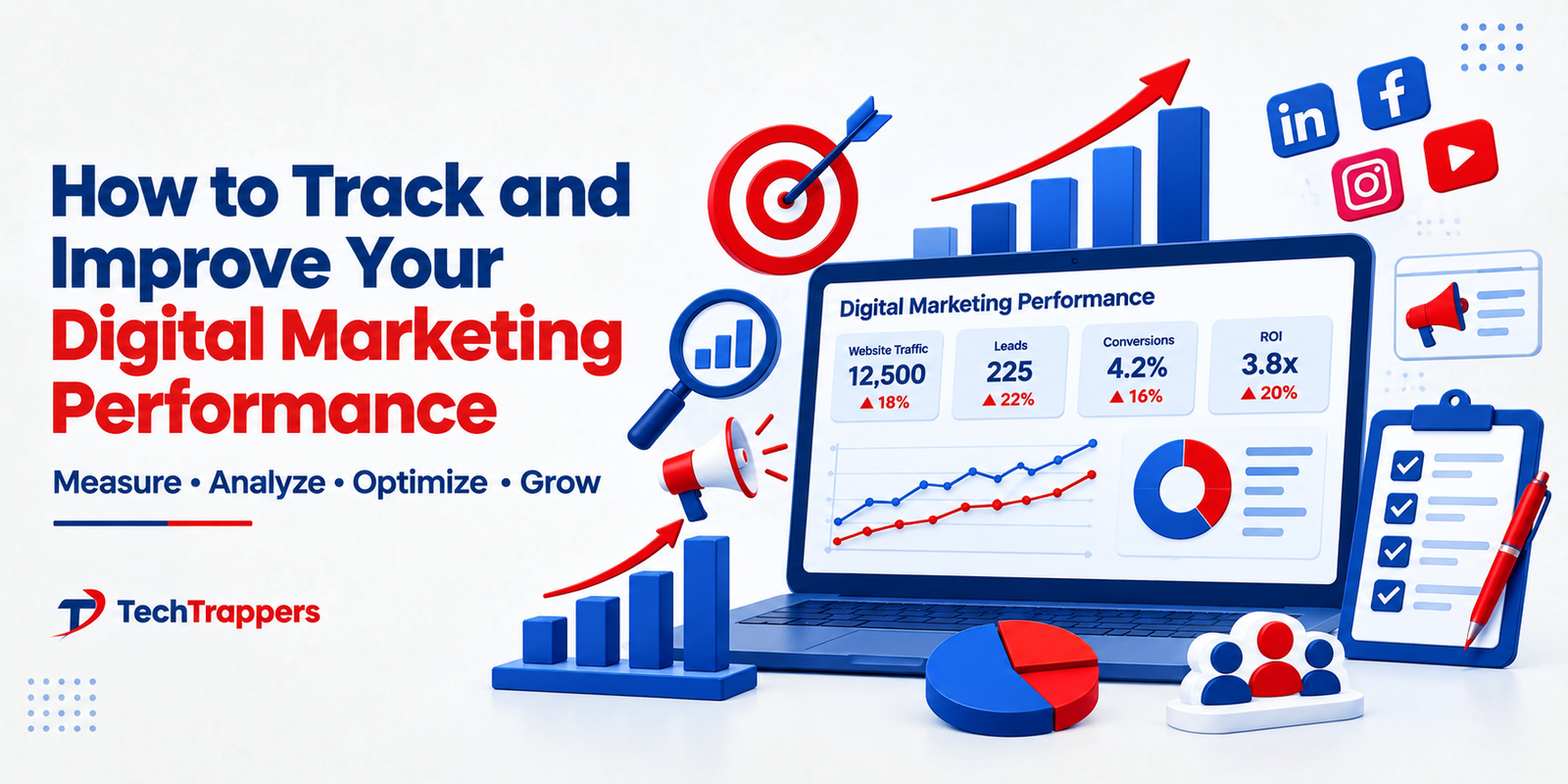
Getting website traffic is easy to celebrate, but traffic alone does not guarantee business growth. If visitors are not becoming leads, customers, or repeat buyers, your marketing strategy needs a closer look.
Learning how to track and improve your digital marketing performance helps you understand what is working, where your budget is going, and which campaigns deserve more attention. Whether you manage SEO, paid ads, social media, content marketing, or email campaigns, the right data can turn marketing activity into measurable business results.
Why Digital Marketing Performance Tracking Matters
Digital marketing produces large amounts of data. The challenge is knowing which numbers actually matter.
A strong performance measurement strategy connects marketing activities with business goals such as leads, sales, revenue, customer acquisition, or brand growth.
Instead of asking only, “How much traffic did we get?” ask:
- Did traffic come from the right audience?
- Which channels generated leads?
- Which campaigns produced sales?
- How much did each customer cost?
- Which pages or campaigns generated the best return?
This approach helps businesses make decisions based on evidence rather than assumptions.
Measure Business Goals, Not Vanity Metrics
Metrics such as followers, impressions, and page views can provide useful context, but they should not be your only measures of success.
For example, a campaign that generates 50,000 impressions but zero qualified leads may be less valuable than a campaign that generates 5,000 impressions and 100 leads.
Key takeaway: Track metrics that connect marketing activity to meaningful business outcomes.
Key Digital Marketing Metrics to Track
Your ideal KPIs depend on your business model and marketing goals. However, several metrics are useful across most digital marketing strategies.
Website and SEO Metrics
For organic search and website performance, monitor:
- Organic traffic
- Search impressions
- Click-through rate (CTR)
- Keyword rankings
- Landing-page conversions
- Engagement and user behavior
- Leads generated from organic search
Google Search Console provides data on clicks, impressions, CTR, and search queries, making it useful for identifying pages and queries that need optimization.
For example, if a page receives many impressions but has a low CTR, improving its title and meta description may help attract more qualified clicks.
Paid Advertising Metrics
For Google Ads, Meta Ads, and other paid campaigns, track:
- Click-through rate
- Cost per click (CPC)
- Conversion rate
- Cost per acquisition (CPA)
- Return on ad spend (ROAS)
- Total conversions
- Revenue generated
Looking at several metrics together provides better insight than focusing on clicks alone.
Social Media and Content Metrics
For social media and content marketing, monitor:
- Engagement rate
- Reach
- Website traffic
- Shares and saves
- Leads
- Assisted conversions
- Content-driven revenue
The goal is to understand whether content attracts the right audience and moves people toward a desired action.
How to Track Digital Marketing Performance
1. Set Clear Marketing Goals
Start with specific goals that support your business objectives.
For example:
Goal: Generate more qualified leads.
KPIs: Organic leads, conversion rate, cost per lead, and lead-to-customer rate.
A clear goal makes it easier to choose the right metrics and avoid unnecessary data.
2. Use Analytics and Tracking Tools
Use reliable analytics platforms to collect and compare marketing data.
Google Analytics can measure important user actions as key events and help you understand how different channels contribute to those actions.
Useful tools include:
- Google Analytics
- Google Search Console
- Google Ads
- Meta Ads Manager
- CRM software
- SEO platforms
- Website analytics tools
Make sure important actions such as form submissions, purchases, calls, or sign-ups are tracked correctly.
How to Improve Digital Marketing Performance
Tracking data is only the first step. The real value comes from using those insights to improve your strategy.
Optimize Underperforming Campaigns
Identify campaigns that receive traffic or engagement but produce weak results.
For example, if a paid campaign has a high CPC and low conversion rate, review its:
- Audience targeting
- Ad copy
- Keywords
- Landing page
- Offer
- Call-to-action
Do not immediately increase the budget. First determine why performance is weak.
Improve Conversion Rates
More traffic is not always the answer. Sometimes the fastest improvement comes from converting existing visitors more effectively.
Test elements such as:
- Headlines
- Calls-to-action
- Forms
- Landing-page copy
- Page speed
- Trust signals
- Offers
- Mobile experience
For example, reducing a long lead form from eight fields to four may make it easier for visitors to submit their information.
Test and Refine Your Strategy
Digital marketing should be an ongoing process of testing, learning, and improving.
Try A/B testing different headlines, creative formats, audiences, landing pages, or offers. Compare results over a meaningful period before deciding which version performs better.
Cross-channel measurement can also help businesses understand how paid and organic channels contribute to conversions and marketing outcomes.
Common Digital Marketing Performance Mistakes
Avoid these common problems:
- Tracking too many metrics instead of focusing on meaningful KPIs.
- Ignoring conversion tracking and measuring only traffic.
- Making decisions from short-term fluctuations.
- Failing to segment audiences and channels.
- Ignoring mobile users.
- Changing several variables at once, making results difficult to interpret.
- Using keywords unnaturally simply to increase keyword frequency.
Google’s Search spam policies specifically identify keyword stuffing as a manipulation tactic. Creating useful content for people and using relevant terms naturally is a safer long-term SEO approach.
Conclusion
Effective digital marketing is not about collecting the most data; it is about turning the right data into better decisions. By setting clear goals, tracking meaningful KPIs, monitoring conversions, analysing channels, and continuously testing improvements, businesses can make their marketing more efficient and profitable.
If you want to track and improve your digital marketing performance, start with a small set of business-focused KPIs and review them consistently. Use your findings to improve campaigns, content, SEO, landing pages, and customer journeys. For more practical digital marketing and SEO strategies, explore related resources from TechTrappers and build a data-driven growth strategy.